
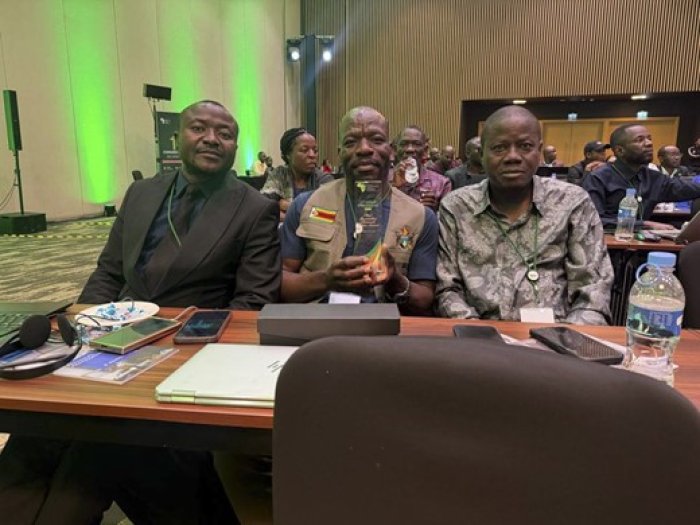
Crypto-tax research wins continental award as Zimbabwe fields four papers at Africa's largest tax research meeting
KIGALI, Rwanda — A study of how Zimbabwe should tax cryptocurrencies has won the Best Innovative Research Paper Award at the 11th Annual Congress of the African Tax Research Network (ATRN). The congress was hosted by the African Tax Administration Forum (ATAF) in Kigali from 22 to 24 September 2026.
The winning paper was written by Dr Gift Mupunga, Head of Research and Innovation at the Zimbabwe Revenue Authority (ZIMRA). It was one of four papers presented by a ZIMRA team. The team also covered tax expenditures, corruption and tax morale, and automatic exchange of tax information across borders.
The award puts Zimbabwe among the continent's leading contributors to tax research. That research increasingly shapes how African governments raise revenue at home.
A congress that keeps growing
The congress met at the Kigali Convention Centre under the theme Contemporary Taxation Issues in Africa. It was co-hosted by the Rwanda Revenue Authority (RRA). Researchers, policymakers, tax administrators and development partners came from across Africa and beyond to look for evidence-based ways to strengthen tax policy and domestic revenue mobilisation.
This year the ATRN received 190 research paper submissions, up from 120 in 2024. That is an increase of nearly 60 per cent, and it shows growing interest in research on Africa's most pressing tax problems.
ATAF said 164 of the submissions went through double-blind peer review. A Scientific Committee of 114 members completed 356 individual reviews. From these, 48 papers were accepted for full presentation and seven for poster presentation. Another 40 were placed on a mentoring track to help their authors develop their work.
Opening: “No finance ministry can close a tax gap it has not measured”
Rwanda's Minister of Finance and Economic Planning, Yusuf Murangwa, opened the congress. He argued that Africa needs stronger research infrastructure to design tax policy and judge whether reforms work. “Good tax policy, like good statistics, depends on evidence gathered honestly, tested rigorously,” he said. “No finance ministry can close a tax gap it has not measured.”
The Commissioner General of the Rwanda Revenue Authority, Ronald Niwenshuti, said revenue growth should come from better compliance, not more taxes. “Improved revenue collection is not a question of how many new levies we can introduce,” he said. He reported that the RRA reached 104.2 per cent of its target in the financial year to June 2026, with collections up 27.7 per cent. He credited data-driven enforcement, electronic billing and building taxpayer trust.
Niwenshuti also announced a Tax Tech Incubator Programme, so African administrations can share technology solutions. “An administration that holds its innovations serves only itself; one that shares them serves the continent,” he said. He warned that an administration that “treats research as decoration” will “eventually find itself poorly governed”.
Emeka Nwankwo, ATAF's Head of Domestic Tax and Capacity Building, spoke on behalf of ATAF Executive Secretary Mary Baine. He set out what is at stake. “On a continental output of roughly three trillion dollars, each additional percentage point of GDP raised in tax is worth in the order of thirty billion dollars a year,” he said.
Nwankwo said the ATRN's mentoring track means “we are not only selecting excellence; we are developing it”. He added that “the road from 15 per cent of GDP to the levels our peers on other continents already reach will not be built on borrowed models”.
Zimbabwe's four papers
Taxing crypto-assets (award winner). Dr Mupunga's paper looks at how Zimbabwe can bring a fast-growing but largely informal crypto market into the tax net. He estimates that about 12 per cent of Zimbabwean adults used crypto-assets by 2024, up from under 2 per cent in 2019. Much of this trading happens peer-to-peer, offshore or in cash, out of sight of the tax system.
The paper finds that Statutory Instrument 99 of 2026 was a turning point. It brought crypto service providers under Financial Intelligence Unit registration, identity checks and the international “travel rule”. But Mupunga argues that SI 99 is an anti-money-laundering tool, not a tax code. Zimbabwe still needs law that defines crypto as property, sets out when gains are taxable and how they are valued, and requires providers to report to ZIMRA.
Comparing India, Japan, the United States, Germany, South Africa and Brazil, he recommends a balanced, asset-based approach over punitive rates. He proposes a simplified regime for small businesses and early preparation for the OECD Crypto-Asset Reporting Framework, which several African countries will start using in 2027 and 2028.
Tax expenditures. Benjamin Chaya, a ZIMRA Research Analyst, analysed Zimbabwe's tax incentives and exemptions. Between 2015 and 2022 they averaged about US$2.16 billion a year, equal to 51.9 per cent of tax revenue and 6.02 per cent of GDP. Both figures are well above global averages. Using a Python-based microsimulation model on 2024 company tax returns, he estimates corporate tax expenditures at about US$555 million, or 1.21 per cent of GDP. He called for an annual tax expenditure report, sunset clauses on incentives and a whole-of-government monitoring framework.
Corruption and tax morale. Judith Tambama used Afrobarometer survey data on 1,457 Zimbabwean adults. She found that people who had paid a bribe for a public service were 7.2 percentage points less likely to say that not paying tax is wrong and punishable. People who found tax information easy to get were 15.2 points more likely to hold that view. Her conclusion: “the fiscal relationship is experienced before it is enforced”. Integrity and clear information build willing compliance.
Bridging the technical divide. Jeremiah Makumba addressed a practical barrier to international tax transparency. Many African tax authorities have signed agreements to exchange financial account data automatically, but their older IT systems cannot produce the data in the formats the OECD requires. He proposed an “African Interoperability Adapter”. This is low-cost middleware that extracts, translates, validates and securely sends data without replacing core systems. He urged ATAF to develop an open-source reference version for the continent.
From research to reform
The papers point in the same direction as the opening speeches. Africa can raise more revenue by closing gaps, managing incentives better, earning taxpayer trust and using data well, rather than by adding new taxes.
For Zimbabwe the congress offered both recognition and a practical agenda: legislating for crypto-assets, reporting openly on tax expenditures, making integrity visible at every point of contact with taxpayers, and building the systems needed for international information exchange.
As Minister Murangwa told delegates, a gap cannot be closed until it is measured. Zimbabwe's researchers went to Kigali with measurements and came home with the continent's top prize for innovation.