
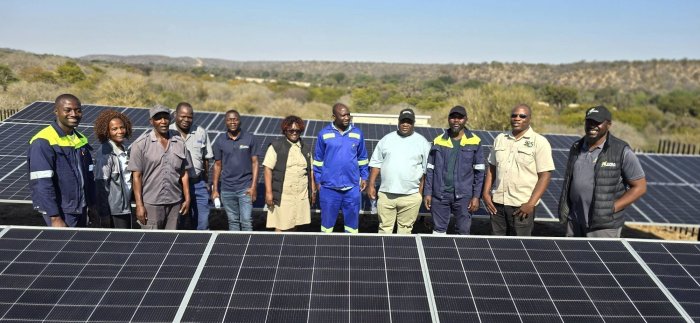
The Zimbabwe Revenue Authority (ZIMRA) has installed a 40 kVA solar power system to power the newly upgraded Mlambapele Border Post and Staff Accommodation comprising 68 solar panels, each rated at 585 watts. Thirty-six panels were installed to power the border post, while 32 panels supply the Staff Accommodation. This was supplied and delivered by Sypremo Investments.
Commenting on the efficiency of the installation, Mr Denford Munemo from the ZIMRA Engineering Department said the system had been designed to provide dependable and sustainable power for the new facility.
“The 40 kVA solar system provides an efficient and reliable source of electricity for the newly constructed border post and Staff Accommodation. Its solar generation and battery-storage capacity will help minimise power interruptions, support continuous border operations and reduce dependence on conventional energy sources,” said Mr Munemo.
Collectively, the panels have an installed generation capacity of approximately 39.78 kilowatts peak. The border post installation accounts for approximately 21.06 kilowatts peak, while the Staff Accommodation installation has a capacity of approximately 18.72 kilowatts peak.
The border post is also supported by five 48-volt, 200-ampere-hour batteries, providing an estimated combined nominal storage capacity of 48 kilowatt-hours. The battery storage will help maintain electricity supply when solar generation is reduced or unavailable.
By providing a reliable source of electricity, the system will support border-processing equipment, communication systems, lighting and other facilities required for the efficient facilitation of trade and travel.
Reliable power will help minimise disruptions, improve the processing of travellers and goods, and enable officers to serve clients more efficiently. The system will also improve the living and working conditions of officers stationed at the border post.
Beyond enhancing operational reliability and staff welfare, the project supports ZIMRA’s commitment to Environmental, Social and Governance principles.
The adoption of solar energy reduces dependence on conventional electricity sources and diesel-powered generators, contributing to lower fossil-fuel consumption, reduced greenhouse-gas emissions and a smaller carbon footprint.
The project demonstrates how renewable energy can power modern border infrastructure, strengthen service delivery, enhance staff welfare and promote environmentally responsible border management.
Mlambapele Border Post is located along the border between Zimbabwe and Botswana, southwest of Gwanda and approximately 130 kilometres from the town. The border post serves members of the general public and traders from surrounding communities, including Manama in Zimbabwe and the Mabolwe settlement in Botswana, facilitating the movement of people and goods between the two countries.