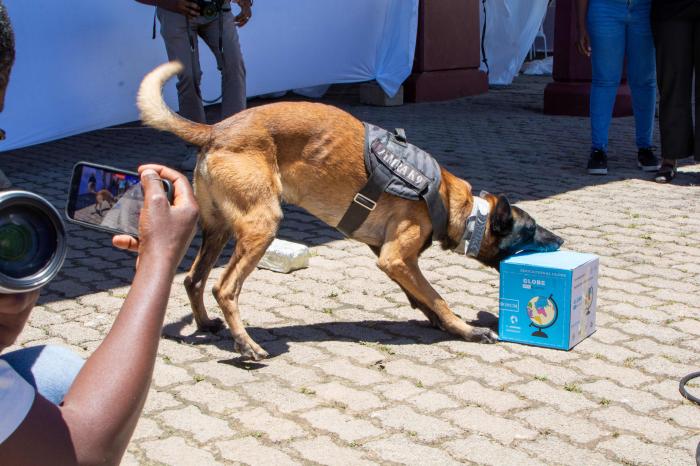
Customs dogs and their handlers help protect a country’s economy by prohibiting smuggling that costs the country millions. These dogs save lives indirectly, by stopping dangerous substances or illegal products from entering or exiting the country.
Dogs sense of smell is so powerful that they can detect a single drop of a different liquid in an Olympic-sized swimming pool.
The official Zimbabwe Revenue Authority (ZIMRA) K9 programme began publicly in 2013.
A customs dog can screen hundreds of passengers and their luggage in minutes, much faster than human officers can achieve alone.
Sniffer dogs don’t work all day. They get breaks, playtime, and rest because scent work is physically tiring.
K9 Officers have to rotate their dogs between intense work and rest, because smell detection is mentally taxing.
Dogs are taught to give a signal (like sitting, staring, or pawing) when they detect what they’re trained for. Most customs dogs are ‘passive detectors’ - instead of barking or scratching, they simply sit or stare at their handler as an alert of a detection.
They can smell up to 100,000 times better than humans. Their noses can pick up tiny scent particles humans can’t even imagine.
A dog’s nose has up to 300 million scent receptors, while humans have about 5 million.
Dogs do not actually smell ‘stronger’- they smell separately, which means they can detect each ingredient of a scent one by one.
Primary detection targets include drugs, contraband medicine and alcohol, currency, and prohibited agricultural products. ZIMRA K9s have been used in multiple drug and contraband seizures.
These dogs learn to ignore common travel smells (perfumes, smell of food, clothing scent) and focus only on what they are trained to detect.
A customs dog’s career usually lasts 8-10 years; after which they must retire.